
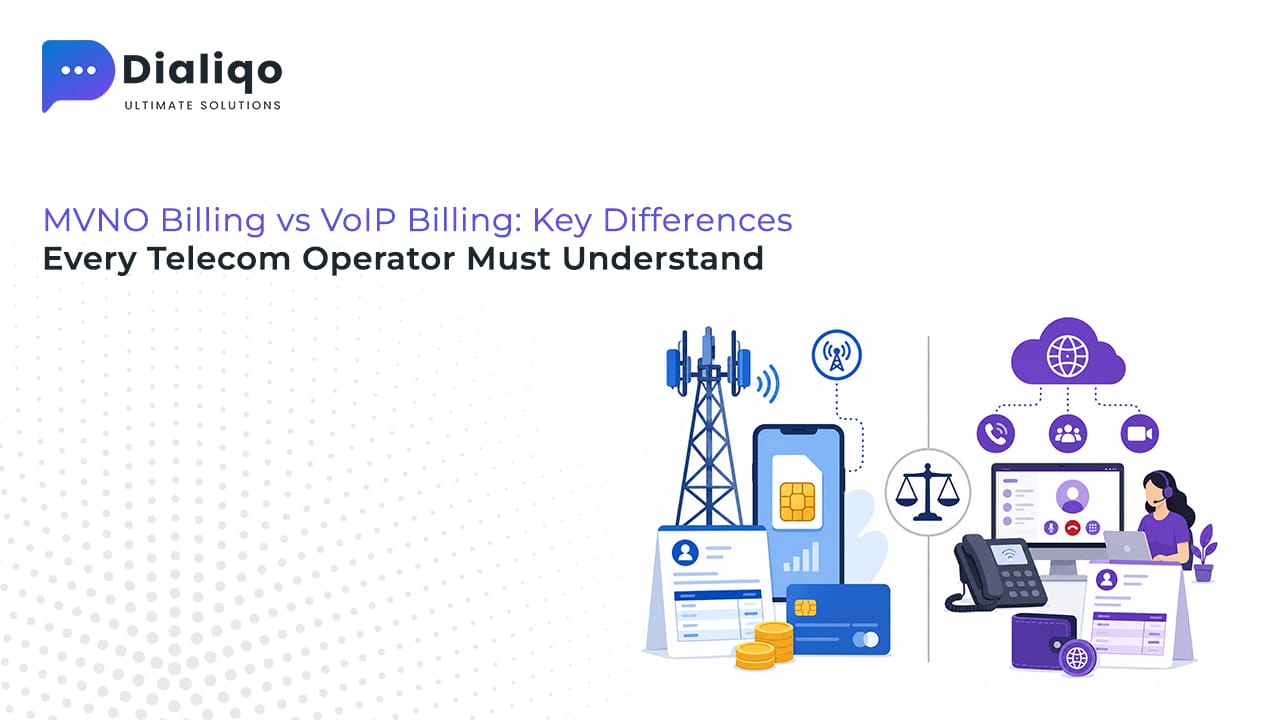
MVNO Billing vs VoIP Billing: Key Differences Every Telecom Operator Must Understand
If you happen to be a telecom operator who wants to increase his range of services offered, then sooner or later you would need to think about designing your billing system. One of the most frequent confusions here concerns the difference between MVNO and VoIP billing solutions. They both imply payment for the use of communication services. They both cover such aspects as call duration, usage statistics, and customer billing accounts. Nevertheless, the technologies and requirements necessary for implementing both types are completely different.
Let’s clarify the distinctions between these two types of services, their similarities, and how to choose the most suitable platform.
What Is MVNO Billing?
A Mobile Virtual Network Operator (MVNO) is an enterprise offering mobile services to customers using the leased capacity of mobile network operators (MNOs). MVNOs do not have ownership of the radio frequency spectrum as well as the network infrastructure.
In addition, the MVNO Billing System is responsible for processing special kinds of data associated with the use of mobile services. It processes call detail records coming from the MNO, performs your price calculation on top of the wholesale prices, processes subscriber SIM management, and manages data packages, roaming fees, SMS data, and others.
Key characteristics of MVNO billing:
- Processes mobile CDRs from the host MNO’s network
- Manages SIM card provisioning and lifecycle
- Handles mobile data bundle allocation and overage charging
- Supports roaming CDR reconciliation
- Manages IMSI-level subscriber identification
- Handles mobile number portability (MNP) records
- Reconciles wholesale invoices from the MNO against subscriber usage
- Supports mobile-specific regulatory requirements (CALEA, E911)
What Is VoIP Billing?
VoIP Billing Software uses the information that has been gathered from the usage logs of the Voice-over-Internet Protocol (VoIP) services. Usage data will come in the form of SIP CDRs or RADIUS accounting. The billing solution then uses the price rules set by you and bills your customers and resellers accordingly.
Key characteristics of VoIP billing:
- Processes SIP CDRs or RADIUS/DIAMETER accounting records
- Handles A-number and B-number based rating
- Supports LCR (Least Cost Routing) integration for termination cost tracking
- Manages DID (Direct Inward Dialing) number inventory
- Supports trunk-level and channel-level capacity billing
- Handles SIP trunking reseller hierarchies
- Manages prepaid and postpaid billing cycles
- Integrates with FreeSWITCH, Asterisk, Kamailio, or OpenSIPS
MVNO Billing vs VoIP Billing: A Direct Comparison
| Dimension | MVNO Billing | VoIP Billing |
| Network type | Mobile (GSM/LTE/5G) | IP-based (SIP/RTP) |
| CDR source | Host MNO mediation layer | SIP proxy / media server |
| Subscriber ID | IMSI / MSISDN | SIP URI / DID number |
| Data services | Mobile data bundles, APN | Not typically applicable |
| Roaming | Critical, complex | Less common |
| Number porting | MNP (complex) | DID porting (simpler) |
| Regulatory | Mobile-specific (E911, CALEA) | VoIP-specific (nomadic E911) |
| Wholesale reconciliation | MNO invoice matching | Carrier CDR reconciliation |
| Hardware dependency | SIM card management | Softphone / SIP device |
Where MVNO and VoIP Billing Overlap
It becomes even more complex as the market matures. In fact, several use cases exist that clearly fall into the overlapping area of both billing systems.
Fixed-Mobile Convergence (FMC)
A situation where a service provider is providing both mobile services and also VoIP services to the same set of subscribers will require an integrated billing system that can handle both types of CDRs for the same account. This will be complex if two billing systems are used.
WiFi Calling / VoWiFi
An MVNO that is providing WiFi calling requires CDR processing using the SIP protocol while at the same time generating mobile CDRs for calls made via the cellular connection. The billing system must manage both types of CDRs.
OTT VoIP in MVNO
Certain MVNOs are providing VoIP software applications along with their mobile service. Call CDRs generated by using this application will be VoIP, while those generated by native dialing are mobile.
Choosing the Right Platform: MVNO Billing Platform vs VoIP Billing Software
Telecom billing solutions specifically tailored towards MVNOs include specific functionalities that cannot be integrated into generic VoIP billing platforms; this includes reconciliation of MNO invoices, SIM management, HLR/HSS provisioning integration, and mobile data bundles management. Such functionalities are not readily available in VoIP billing solutions, and they are not addons you can plug into a general VoIP solution effortlessly.
VoIP billing software tailored towards VoIP operators has special functionalities that might not necessarily feature in MVNO billing platforms. These include CDR processing in SIP format, LCR integration, DID management, and a tightly integrated VoIP platform such as FreeSWITCH or Asterisk.
For operations that are purely mobile-focused: Use MVNO billing software. For VoIP-only operations: Use VoIP billing software. For converged operations (VoIP and mobile): either use converged billing software or two specialised solutions coupled with a reconciliation layer between them.
Revenue Leakage: The Biggest Risk in Telecom Billing
Telecom Billing Software that does not process CDRs accurately and in near real time creates revenue leakage. For an MVNO, leakage typically comes from:
- Unprocessed roaming CDRs that arrive with delays from the MNO
- Incorrect application of bundle entitlements
- Failed mediation that drops or duplicates CDRs
- Wholesale rate changes not applied in time
For a VoIP operator, leakage typically comes from:
- CDRs generated by the media server that are not captured by the billing system
- Incorrect LCR cost tracking that understates termination costs
- Prepaid balance validation failures that allow calls to exceed account limits
- Reseller margin miscalculations
Both scenarios share a common root cause: a billing platform that cannot process usage data quickly, accurately, and completely. The solution is real-time or near-real-time CDR processing with exception alerting for any record that fails validation.
Regulatory Compliance Requirements
MVNO and VoIP billing obligations differ by jurisdiction, but both carry obligations that your billing platform must support.
MVNO Regulatory Requirements
- CALEA compliance (lawful intercept support for US operations)
- E911 location data for mobile subscribers
- Number portability compliance
- Mobile subscriber data retention
VoIP Regulatory Requirements
- Nomadic E911 (VoIP providers must support location-based emergency routing)
- STIR/SHAKEN compliance for caller ID verification
- CPNI (Customer Proprietary Network Information) protection
- Applicable data retention obligations
Frequently Asked Questions
Q: Can we use one billing platform for both MVNO and VoIP services?
Unified platforms exist, but they are more complex and typically more expensive than single-purpose solutions. For operators running both services at scale, a unified platform is worth the investment. For smaller operations, two specialized platforms with a shared reporting layer may be more practical.
Q: How does prepaid work differently in MVNO vs VoIP billing?
MVNO prepaid relies on online charging system (OCS) integration, where the network queries the billing platform in real time before allowing each call or data session. VoIP prepaid typically uses a credit check at call setup via the SIP proxy or media server. Both approaches require low-latency real-time authorization, but the technical interfaces are different.
Q: What is CDR mediation and why does it matter?
CDR mediation is the process of collecting raw usage records from network elements, normalizing them into a consistent format, and delivering them to the billing system for rating. Poor mediation is a leading cause of billing errors and revenue leakage. Both MVNO and VoIP billing platforms need robust mediation layers.
Q: How do we handle wholesale cost reconciliation?
For MVNOs, this means matching your billed subscriber usage against the wholesale invoice from your MNO. For VoIP operators, it means matching your termination costs against carrier invoices. Both require CDR-level comparison, dispute management workflows, and margin reporting.
Q: What reporting capabilities should a telecom billing platform include?
Revenue by subscriber, cost by carrier, margin by route or product, CDR exception reports, and regulatory compliance reports are baseline requirements. Real-time dashboards for prepaid balance monitoring and usage alerting add operational value.
Ready to Build or Upgrade Your Telecom Billing Platform?
Dialiqo builds custom MVNO Billing Platforms, VoIP Billing Software, and converged Telecom Billing Solutions for operators at every stage of growth. Whether you need a greenfield billing system or a migration from a legacy platform, our engineering team has the expertise to deliver it.
Contact Dialiqo today to discuss your billing architecture requirements. Visit dialiqo.com for more information on our telecom billing development services.
