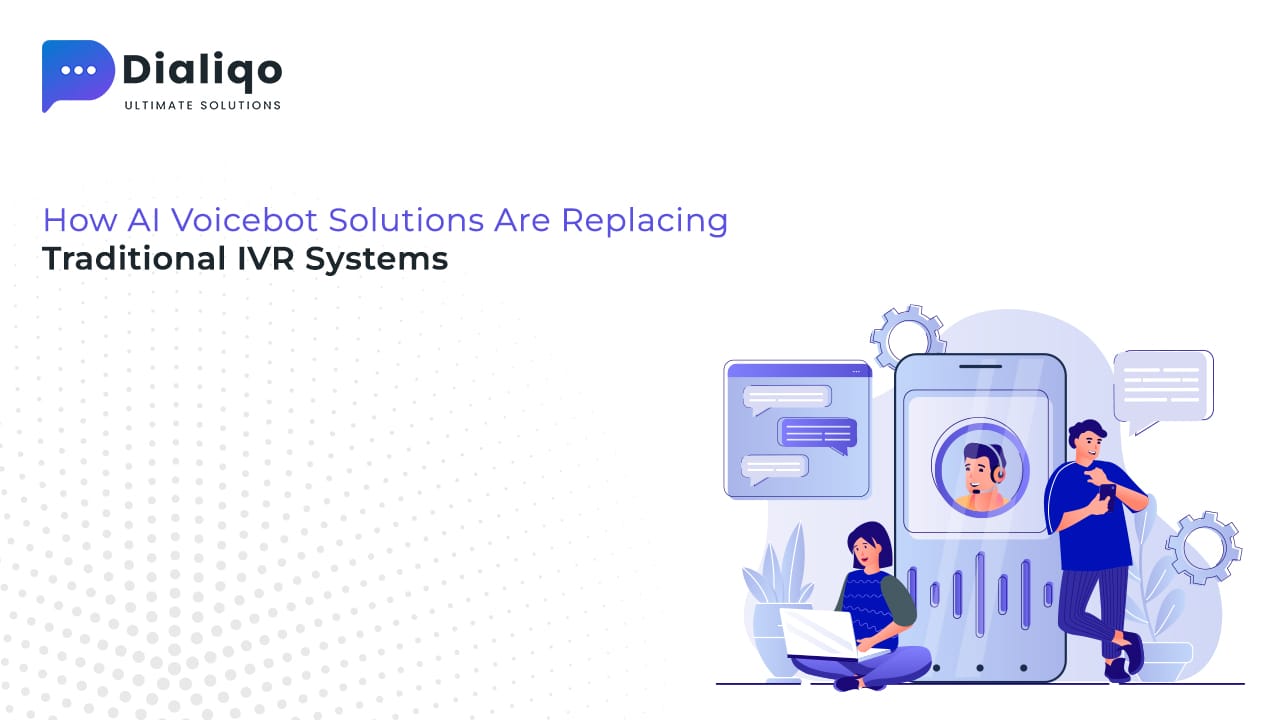
How AI Voicebot Solutions Are Replacing Traditional IVR Systems
If you’ve ever been on the phone with an organization and had to spend the initial ninety seconds dialing in, saying things over and over again, and finally shouting “agent” into the phone, then you know precisely why traditional IVR systems have such a bad reputation. They were designed for the world of telephony decades ago, and today, most people find them more irritating than anything else.
AI voicebot solutions are transforming this entire process from scratch. More specifically, this paper looks into how exactly the voice automation solutions driven by artificial intelligence differ from what we’ve become used to seeing and why the transition to this new standard is taking place.
What Traditional IVR Systems Do (and Where They Fall Short)
Interactive Voice Response, or IVR, has long been the established means for a self-service experience within the call center. This technology relies on a basic approach: the customer receives an audio menu, chooses an option using keystrokes or spoken words, and is guided from there.
This works quite well in scenarios that are simple and straightforward. Pay a bill, check your account balance, or get store hours. In instances where the use case is well-defined and the customer knows exactly what they want to do, an IVR solution can handle a considerable volume of customer service contacts without human intervention.
But things become problematic when callers are looking for something outside the scope of the audio menu. Where their inquiry is just a little bit out of the ordinary. Where they want to jump from one topic to another, or where they are actually calling a second time after trying the IVR system without success.
The problem lies in structure. Decision tree models form the foundation of traditional IVR systems. They recognize specific responses and take preprogrammed branches accordingly. However, they do not reason about intent or ambiguity or make any adjustments based on variations in language. A customer saying “I would like to change my billing date” will be processed the same way as another customer saying “I must change the time of charging from my account.” Both statements have to be programmed into the IVR system for recognition; otherwise, the response is rejected.
This reality shows up in the data. The abandon rate for IVR is high. IVR interactions score lower than live-agent interactions in terms of customer satisfaction. In addition, the bigger and more complicated the IVR tree becomes, the worse the interaction usually gets.
What AI Voicebot Solutions Actually Do Differently
Unlike regular IVR solutions that are upgraded with friendly voices, AI voicebot solutions feature a different architecture from the ground up.
Natural Language Understanding
Rather than reacting to a predefined keyword or button click, an AI voicebot analyzes the actual message of the caller and tries to understand its meaning. It is done by applying a complex combination of ASR models with natural language understanding models.
Such natural language understanding models are pre-trained on huge amounts of conversational data and are able to identify the speaker’s intention rather than exact phrases. Phrases like “There was a duplicate charge on my card” and “I was charged twice” are equally recognized by the natural language understanding model, without having either phrase pre-programmed.
Context Retention
In a conventional IVR system, the context gets lost at once as soon as the user selects something and proceeds ahead to another branch. All actions are in isolation from each other. On the contrary, in an AI IVR system that uses a voice bot, there is always context awareness throughout the conversation. The voicebot knows what you said two conversations back and how it is going to respond now.
Such conversational capabilities make the interactions much more natural than before. For instance, a customer can inquire about his/her balance, then inquire about any recent transaction, and then request a dispute of the same in one smooth conversation.
Dynamic Response Generation
The conventional IVR solution makes use of prerecorded audio. The AI voicebots make dynamic replies; this implies that they have the capability of integrating individual caller details from the customer relationship management (CRM) systems in generating a natural reply to a query. In this case, it will not say, “your account information is available on our self-service portal.” Instead, it says, “Your account balance is $147.32, and you have a payment of $X due on the 15th.”
Continuous Learning
An effective AI voicebot solution becomes better through continuous learning. Call transcriptions are studied to establish where calls were failed, when the calls were transferred to agents, and the questions that could not be handled by the voicebot.
Intelligent Call Routing: The Backbone of AI-Driven Contact Centers
One of the immediate advantages of using a voicebot as compared to the traditional IVR system would be the changes in call routing. Intelligent call routing, made possible by the use of AI technology, goes far past the conventional method that only involved pressing the 2 key for billing.
Intent-Based Routing
Instead of following the method that involved routing calls according to the keys pressed by the caller, the call center agent could route their call according to what the client has said. Someone who says, “I have been thinking about canceling my subscription,” will not go into the general customer care department but be sent directly to someone who handles such requests.
Caller History Integration
With intelligent routing enabled by your CRM system, a high-priority account holder who is calling with a previous unresolved issue will automatically be connected to a senior handler regardless of what they are calling for. This will also allow a new caller to be connected to agents trained specifically for that purpose.
Real-Time Queue Management
An AI routing engine can make changes in response to current conditions in the queues. For example, if the billing queue has more than the usual number of agents waiting, a customer calling with a billing inquiry may receive an alternative offer such as a callback, a change of medium, or an agent from another team that is competent in billing.
Skills-Based Routing with AI Assistance
The AI for contact centers is more advanced than simple skills-based routing since it involves skills and contextual-based routing. This means that the skills and availability of the agent will be considered by the system along with the context created by the conversation between the AI and the customer at the start of the call.
AI Voicebot Connectors: Integrating AI with Your Existing Infrastructure
Compatibility with existing telephony systems is a key issue in the assessment of AI voicebot solutions. Most companies have spent huge sums of money on their contact centers, and ripping and replacing the system is not a good solution.
AI Voicebot Connectors solve this issue. Instead of ripping and replacing your VoIP contact center platform, connectors enable integrating the AI voicebot layer with your existing solution via well-defined interfaces.
Possible integration paths include:
SIP-based integration: In this case, the voicebot works as a SIP endpoint. Your company’s IVR/ACD will send the call to the voicebot via SIP protocol, which will engage in conversation with the customer before transferring the call to a live agent or executing self-service.
REST API integration: The voicebot makes REST API calls to your CRM and ticketing software while handling the conversation, thus allowing the retrieval of account data, creation of tickets, and update of records.
WebRTC integration: For digital-only contact centers, voicebot capabilities can be integrated into web and mobile applications using WebRTC technology.
CTI integration: Using computer telephony integration, the conversation summary and customer context are automatically passed to the agent’s desktop when the voicebot forwards the call to an agent.
Business Cases: Where AI Voicebot Solutions Deliver Measurable ROI
High Volume Inbound Call Deflection
For businesses receiving a large number of repetitive inbound calls, the implementation of voicebots results in a direct reduction in the volume of calls received by live agents. Common containment rates range between 40 and 70 percent for successful implementations, resulting in agents having more time to deal with more complicated issues.
After-Hours Coverage
The implementation of voicebots does not require adherence to any specific business hours. A customer reaching out late at night will receive a fully personalized response, their account information, and service without having to wait until office hours start again. Businesses offering such a service report considerable improvements in their first contact resolution rate due to customers getting help immediately.
Multilingual Support
An AI voicebot can operate in several languages without needing agents capable of speaking those languages. This approach can benefit businesses with multinational client bases in terms of reducing costs while also improving customer satisfaction.
Consistency
While human agents can provide a great customer experience, they tend to make mistakes and lose their focus as time goes on, especially towards the end of the day. Voicebots do not suffer from this problem and maintain their quality throughout millions of interactions.
Implementation Considerations
Training Data Quality
The quality of data used to train an AI voicebot is paramount. For successful deployment, it is crucial to obtain representative samples of actual usage scenarios for your company: words customers use, frequent questions, and regional pronunciation. Early access to the necessary data will make a great difference in terms of starting performance.
Escalation Strategy
It is imperative to define a specific escalation strategy at the planning stage for any voicebot deployment. Not every call should or can be managed by automation. An efficient handoff process requires thoughtful preparation and design of an optimal experience.
Monitoring Performance
Metrics such as containment rate, customer satisfaction, self-service completion rate, and escalation causes should be periodically reviewed. It is important to note that voicebot performance changes over time as your offerings evolve. Therefore, constant monitoring and maintenance are necessary.
Compliance Considerations
AI voicebot communication is subject to regulatory compliance requirements to the same degree as agent communication. Recording and data storage policy needs to take voicebots into account as well. Disclosures must be made in voicebot dialogue the same way as in the case of an agent.
Frequently Asked Questions
Q: How long does it take to deploy an AI voicebot for a contact center?
A: A basic deployment with core self-service flows typically takes eight to fourteen weeks. A full-featured deployment with CRM integration, complex routing logic, and multilingual support can take four to six months depending on your existing infrastructure.
Q: Will AI voicebots make our agents redundant?
A: In most deployments, voicebots do not eliminate agent roles. They change the nature of agent work, shifting it toward complex, high-judgment interactions that require human empathy and decision-making. Agents in voicebot-augmented contact centers typically handle fewer calls but more challenging conversations.
Q: How do callers react to AI voicebots?
A: Caller acceptance has improved significantly as the technology has matured. Callers are generally more accepting of AI when it works well, meaning when it understands them on the first try and handles their request efficiently. Poor implementations that misunderstand frequently create frustration. The quality of implementation drives acceptance more than the presence of AI itself.
Q: Can we start with AI for specific call types and expand later?
A: Yes, and this is often the recommended approach. Starting with high-volume, well-defined use cases (balance inquiries, appointment scheduling, order status) builds organizational comfort with the technology and generates the data needed to expand into more complex use cases.
Q: What happens when the voicebot does not understand the caller?
A: A well-designed voicebot handles this gracefully, attempting one or two clarifying questions before offering to connect the caller with a live agent. The escalation should be frictionless and should not require the caller to start the conversation over.
Q: Can an AI voicebot handle emotional or upset callers?
A: AI voicebots can detect sentiment through tone analysis and respond with appropriate language. However, escalation to a live agent is often the right response for an upset caller. A good voicebot recognizes when the interaction has exceeded its appropriate scope and escalates proactively.
Conclusion
The traditional IVR system served its purpose well for quite some time, but it is becoming increasingly difficult to ignore its shortcomings when a better technology solution can easily be provided.
AI voicebot solutions provide an entirely different experience for the callers. It is based on comprehension, not decision trees; memory of the previous actions performed, not just another button pressed; and continuous learning and improvement, not just being configured once.
Build Your AI Voicebot with Dialiqo.
The specialists at Dialiqo help you create a fully functional AI voicebot and AI IVR system tailored specifically to your business needs. We create, develop, deploy, and optimize the solutions to fit into your telephony platform.
Dialiqo creates AI Voicebot Connectors, which allow your existing telephony platform to benefit from AI-powered voice automation.
Contact Dialiqo today to talk about your contact center automation projects!
Learn more about our AI for contact center development services on dialiqo.com.
