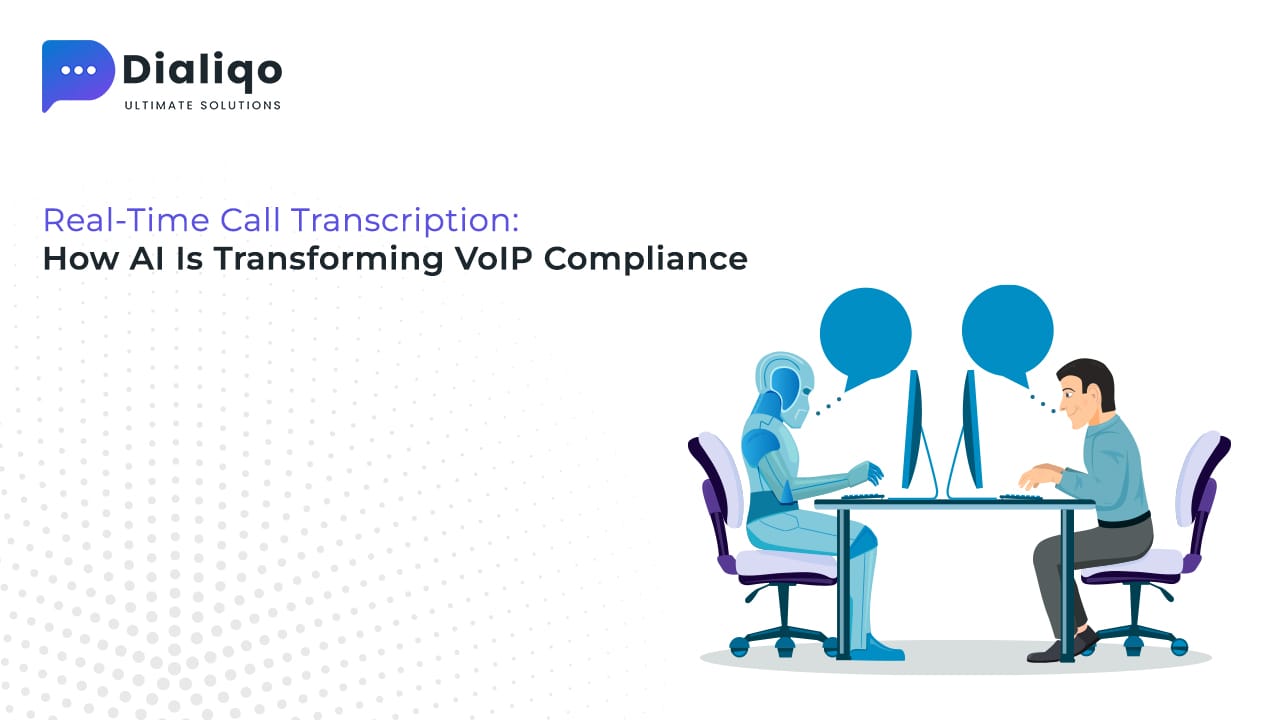
Real-Time Call Transcription: How AI Is Transforming VoIP Compliance
Compliance is always a challenge when managing a business via voice calls. No matter whether you are dealing with finance, healthcare, law, customer service, or anything else, authorities expect proof that your employees comply with all the requirements every minute on the phone. Manually analyzing recorded conversations was the only option previously – until real-time call transcription became possible thanks to AI technology.
In this guide, we will explain to you what real-time transcription actually is, why your organization can benefit from integrating AI voice transcription into your compliance strategy, and how to create the most effective transcription system.
What Is Real-Time Call Transcription?
Real-time call transcription refers to a procedure that transcribes the speech in an active telephone conversation into text form instantly rather than after the conversation has taken place. While post-conversation transcription requires uploading of the recorded conversation and waiting for its conversion, real-time solutions convert audio streams instantly and create transcriptions within milliseconds of the spoken phrase.
In terms of VoIP companies, such a feature implies a revolution. Since your calls are transmitted digitally as a set of data packets using IP telephony protocols, it allows your AI-powered models to extract the audio stream and transcribe conversations without requiring new devices.
Why VoIP Compliance Is Getting Harder to Ignore
Call-based enterprises have experienced increased regulatory pressures. These are some of the issues that organizations face today:
MiFID II in Financial Services: In the US and EU, financial institutions are required to record, store, and retrieve all client communications. Regulators will ask for transcripts within limited notice periods.
HIPPA in Healthcare: Any patient communication containing protected health information needs to be managed, stored, and reviewed through stringent compliance practices.
Payment Card Industry Data Security Standard: If your agents obtain the card numbers over the phone, you require systems that can detect and mask these automatically.
FTC and TCPA Regulations: For outbound call centers, specific scripts, disclosures, and documentation of consent are required.
Manually reviewing calls picks out only about 2 to 5% of the total call volume. This is the space in which your company runs into trouble. VoIP Compliance Solution based on AI Transcription changes the entire ratio of this equation.
How AI Voice Transcription Works Inside a VoIP Stack
Understanding the technical side helps you make better decisions when choosing a vendor or building your own system.
A typical AI Voice Transcription pipeline inside a VoIP environment works like this:
Step 1: Audio capture at the SIP layer: Your SBC or media server makes a copy of the audio from the incoming stream. One copy will go to the endpoint as it normally does. The second audio fork will be forwarded to the transcription engine. This step occurs at the RTP layer and causes no delay to the ongoing call.
Step 2: Speech-to-text processing: The audio fork is fed into an artificial intelligence engine built to process conversational speech. Modern engines rely on transformer architectures capable of handling accents, noise, crosstalk, and industry-specific terminology. The transcription happens near real-time and in less than half a second, typically.
Step 3: NLP and compliance checks: Raw transcription goes through a natural language processing filter. NLP performs several operations simultaneously: identifying speakers, spotting compliance keywords or omitted disclosures, catching prohibited language, and assessing how well your agent sticks to the script.
Step 4: Alerting and intervention: Upon detecting a potential violation, the system may alert a manager, prompt your agent in real time, or simply record the violation so you can analyze it right away. That’s the main advantage of using real-time monitoring over recording and reviewing after the fact. You don’t miss anything.
Step 5: Storage and retrieval of transcripts and metadata: Transcribed calls are automatically saved to an encrypted database along with metadata. Compliance officers can look up calls by keyword, date, agent ID, or violation type almost instantly.
Key Benefits of Real-Time Transcription for VoIP Compliance
1. 100% Call Coverage
There is no way for your compliance team to listen to every single call manually. With a properly configured AI call transcription service, all calls will be automatically reviewed.
2. Faster Violation Detection
Since real-time transcriptions are performed, the supervisor can join a call mid-conversation to resolve any issues that may arise. This is impossible with after-the-fact recordings.
3. Lower Operational Costs
One of the best ROI benefits of adopting an AI-powered solution is reduced expenses on manual call reviews. Instead, you need just one machine to replace a dozen human reviewers.
4. Better Agent Coaching
Managers responsible for staff training will now have written documentation of how agents respond to objections and disclosures. With hundreds of calls being reviewed daily, you will find many training opportunities in these transcripts.
5. Audit-Ready Documentation
You will not need to dig up your hard copies of audio recordings in case a regulator comes knocking. The transcript of each call will be available within seconds.
6. PII and Payment Data Masking
Today’s AI solutions will automatically mask all personal information, credit card numbers, and Social Security numbers from each call. It will save you from non-compliance fines.
Real-Time Transcription vs. Post-Call Transcription: Which Do You Need?
Both approaches have their place. Here is how to think about the choice:
| Factor | Real-Time Transcription | Post-Call Transcription |
| Compliance intervention | During the call | After the call |
| Agent coaching | Immediate feedback possible | Delayed feedback |
| System complexity | Higher | Lower |
| Cost | Higher upfront | Lower upfront |
| Coverage | 100% | 100% |
| Regulatory suitability | High-risk industries | Lower-risk industries |
However, when working in a highly regulated industry, where violations mean heavy fines and legal liabilities, then it is worth investing in a real-time solution. Otherwise, if your goal with transcription is quality assurance or training, then post-call will do.
Building Real-Time Transcription into Your VoIP Platform
Dialiqo works with organizations that require transcription capability to be incorporated into their VoIP infrastructure rather than being added later. A few considerations that come into play:
Latency management: As transcription increases the computational burden, you must ensure that your system is prepared for the peak volume of calls without compromising on audio quality. In most cases, it requires proper configuration of the media servers and optimal handling of the RTP streams.
Speaker diarization: With respect to a typical two-party call, it is essential to distinguish between agent text and caller text. This point is particularly important in relation to compliance scoring.
Domain-specific vocabulary: Speech recognition models cannot recognize industry-specific terminology and acronyms correctly. Financial services companies should use transcription models capable of distinguishing between such terms as LIBOR, fiduciary, and margin call.
Integration with your CRM or WFM system: To maximize its potential, transcription data needs to be incorporated into your CRM or WFM systems. Independent transcription silos provide less value to your organization.
Compliance rules configuration: It is important to configure your NLP layer according to your organization’s regulatory requirements. In this regard, healthcare calls differ significantly from collections calls, for example.
Industries That Benefit Most
Financial services and fintech: Adherence to scripts, necessary disclosures, suitability disclaimers, and detection of suspicious activities all become easier through real-time monitoring.
Healthcare contact centres: Appointments, insurance confirmations, and clinical triages come with HIPAA requirements that can be captured by transcriptions.
Debt collection and lending: Collectors’ interactions have to comply with the FDCPA and the CFPB. In real-time monitoring, violations can be flagged early enough.
Legal services: Transcription makes documenting consultations, as well as informed consent, much easier and accessible.
Retail and e-commerce customer service: Details of orders, authorization for returns, and customer agreements can all be captured automatically with transcription services.
Common Challenges and How to Solve Them
Challenge: High word error rate on noisy calls Solution: Employ noise suppression techniques at the media server level prior to splitting the audio stream into two parts (one for playing back and another for transcription).
Challenge: Agent resistance to monitoring Solution: Present transcription as a coaching instrument. Point out some successful cases where the agent was able to settle disputes or even receive credit for his work based on the transcript.
Challenge: Compliance rule management Solution: Implement a user-friendly interface that would enable your compliance team to modify the flagging rules without needing a developer’s help.
Challenge: Data privacy and residency Solution: If you are working in accordance with the requirements of GDPR and other similar regulatory frameworks, your transcription system should be able to operate within the approved geographic zones only.
Frequently Asked Questions
Q: Can real-time transcription work with our existing VoIP system without a full rebuild?
A: In most cases, yes. Transcription systems connect at the RTP layer, which means they can work alongside your current SIP infrastructure. A proper integration audit will confirm compatibility.
Q: How accurate is AI transcription on phone calls?
A: Modern systems achieve 90 to 95 percent accuracy on clean audio. With noise suppression and domain tuning, accuracy on telephone-quality audio is typically in the 88 to 93 percent range. That is well above the threshold needed for compliance documentation.
Q: What happens if the transcription system goes down?
A: A properly architected system will fail open, meaning calls continue normally but the transcription feed is temporarily unavailable. Alerts should notify your team immediately and call recording should remain active as a backup.
Q: How long does implementation take?
A: A basic integration with an existing VoIP stack typically takes four to eight weeks. A full compliance platform with NLP rules, alerts, and reporting takes three to six months depending on your requirements.
Q: Is transcription data admissible as evidence?
A: In most jurisdictions, properly maintained transcription records with associated metadata (timestamps, agent IDs, call recording references) can be used in regulatory proceedings. Consult your legal team for jurisdiction-specific guidance.
Q: Can the system handle calls in multiple languages?
A: Most enterprise-grade transcription platforms support multiple languages. However, compliance rule sets are typically language-specific and need to be configured separately for each language your agents use.
Conclusion
Real-Time Call Transcription is no longer an optional tool for companies with regulatory constraints. It is becoming increasingly essential for firms that wish to keep up with compliance without constantly expanding their monitoring staff.
AI voice transcription, real-time natural language processing, and seamless integration into your VoIP compliance solutions framework will provide you with unparalleled coverage, efficiency, and documentation.
Ready to Build Real-Time Transcription into Your VoIP Platform?
We pride ourselves at Dialiqo in the provision of highly customized AI-based call transcription solutions and VoIP compliance platforms designed especially for your environment.
Get in touch with us today at Dialiqo for a technical consultation to understand the role of real-time transcription in your VoIP platform setup.
More information on our VoIP development services is available on dialiqo.com.
